Electric mobility in car parks: integrating EV charging with parking management
Electric mobility is transforming car parks, which are expanding beyond parking spaces to offer new services for drivers.
Adding EV charging takes more than installing equipment. Operators must manage power, identify users, track charging and offer easy ways to pay.
Electric mobility solutions for car parks connect these tasks. This makes daily management easier for operators and charging simpler for drivers.
Here we explain the technologies involved, how they integrate and what to consider when offering an efficient charging service.
What does a car park need to provide EV charging?
Installing chargers requires assessing the facility, electrical infrastructure and user profiles.
An office car park, where vehicles remain for several hours, has different needs from a short-stay facility.
EV charging solutions generally combine four components:
- Charging infrastructure: equipment that supplies energy to vehicles.
- Energy management: tools to control and distribute available power across chargers.
- Identification and payment: systems to activate sessions and collect charges.
- Digital monitoring: platforms to view device status and operations.
Integrating these components allows EV charging to operate as part of a connected parking service.
Technology for integrating electric mobility into parking
Every facility needs a tailored setup. These are the main technologies to consider.
1. Chargers suited to parking duration
First, choose charging equipment with power levels that match typical stay durations.
Alternating current (AC) chargers are suitable for facilities where vehicles remain parked for several hours.
For example, the i+d3 VE SRP22 charging point offers AC charging up to 22 kW and allows charging to be offered as an additional parking service.
Sites needing faster energy replenishment during short stops may wish to consider direct current (DC) chargers.
Choose charger power based on parking duration, available electricity and vehicle needs.
2. Power management for multiple chargers
When several chargers are installed, simultaneous energy demand must be managed.
Dynamic load management adjusts power allocated to chargers according to facility conditions and defined settings.
This makes better use of available capacity and helps reduce the risk of exceeding planned limits.
Dynamic management does not eliminate the need to assess electrical protection, loads and potential infrastructure upgrades.
3. User identification and charging activation
Drivers need a simple way to use charging points.
Depending on the charger and platform, sessions can be started using an RFID card, app or website.
Car parks already using number plate recognition can also consider integrations linking a vehicle's parking stay to its charging session.
This makes administration easier, although LPR cameras are not required to offer charging.
4. Integrated payments and billing
For operators, a major opportunity is managing charging payments alongside other parking services.
For example, digital systems can allow users to locate their parking stay using a registration number, select a charger and start charging from a phone.
With compatible integration, the system can record the transaction and support coordinated administration of parking and energy charges.
At i+d3, solutions such as Pagaelparking support mobile charging management and connection to vehicle parking stays.
The exact functionality depends on the chargers, management platform and configured payment channels.
Explore our parking payment and collection solutions.
How integrated EV charging works at a car park
Consider a facility with chargers connected to its management system.
1. Entering the car park. The driver enters using an accepted method, such as a ticket, number plate or advance reservation.
2. Selecting the charger. After parking in a charging bay, the driver selects the relevant unit through a digital platform.
3. Starting a session. The system checks usage conditions and enables charging.
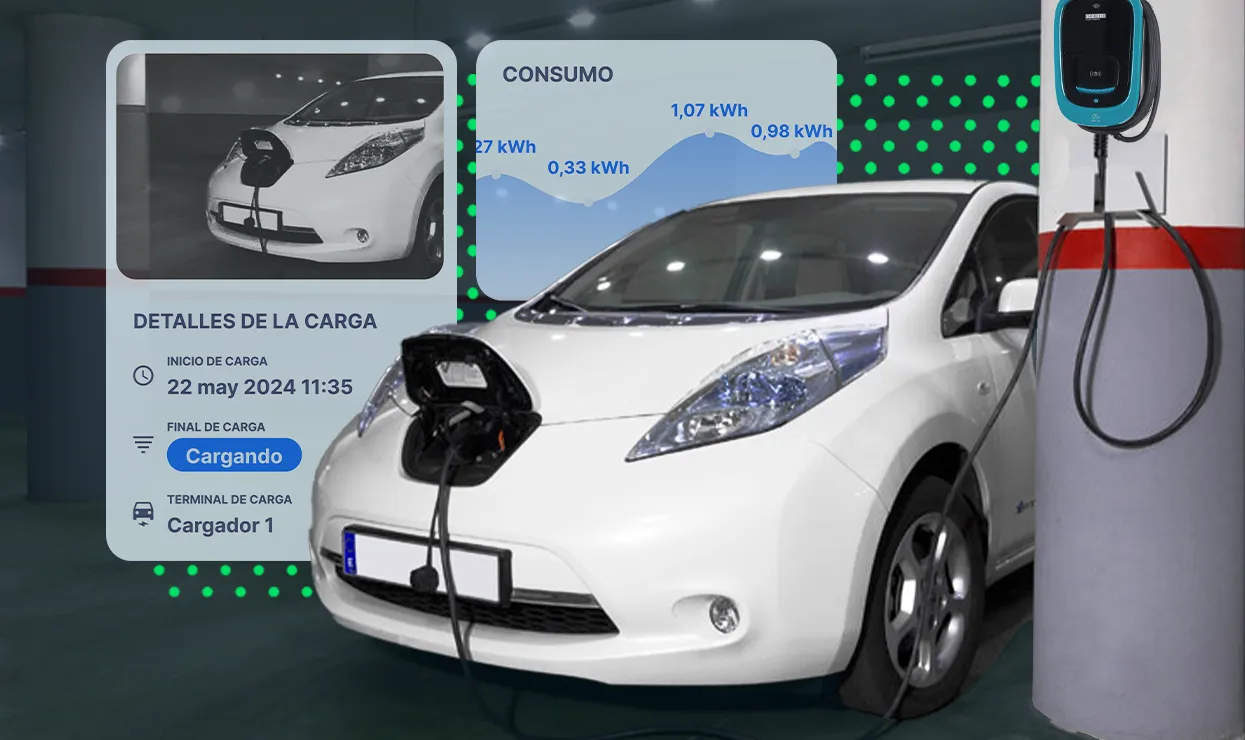
4. Monitoring. The platform may record charger status and energy supplied during the session.
5. Completing and paying. At the end, the driver closes the session and pays according to the car park's configured process.
This is one possible workflow. Available functions depend on installed equipment and enabled integrations.
What does OCPP contribute to charging management?
OCPP (Open Charge Point Protocol) is a communication protocol for connecting chargers with management platforms.
It allows compatible systems to exchange information about charger status and operations.
For example, a platform can check whether a charger is available, running a session or disconnected.
It can also support certain remote actions depending on the protocol version and features implemented by the manufacturer.
i+d3's management solutions include OCPP integration options for monitoring status and reviewing charging session histories.
However, OCPP compatibility does not guarantee that every charger will integrate automatically. Model, firmware version and configuration options must be validated.
Benefits of integrating EV chargers with parking management
Connecting chargers to operational tools creates value beyond simply offering a plug-in point.
Key benefits include:
| Feature | Benefit for the operator |
|---|---|
| Charger status | Check availability and incidents. |
| Charging history | Review sessions and utilisation. |
| User identification | Connect services to customers or parking stays. |
| Integrated payments | Simplify financial monitoring. |
| Power management | Optimise electrical capacity. |
| Centralised information | Monitor activities on one platform. |
These capabilities support service organisation and operational decisions.
Analysing how often each charger is used, for instance, can reveal high-demand locations and help plan future expansion.
How to plan EV charging installation
Before installing chargers, assess current needs and potential growth.
Analyse user demand
Determine how many customers drive electric vehicles, how long they stay and what their charging requirements are.
This helps establish the initial charger count and appropriate power levels.
Review electrical infrastructure
Check available capacity, protection devices, cable routes and possible expansion.
Consider charger bay locations to help access and minimise installation work.
Define the payment model
Before launching the service, decide how users will be identified, what pricing applies and which payment methods will be offered.
These decisions should be reflected in both the management system and the information provided to drivers.
Prepare monitoring and maintenance
Charging services need procedures to detect and resolve problems.
Equipment status information and technical support help schedule interventions and minimise downtime.
How to measure charging point performance
After installation, monitor indicators that show utilisation and efficiency.
Important metrics include:
- Charging sessions: number of sessions per charger.
- Energy supplied: total kWh delivered during a period.
- Availability: time equipment remains operational.
- Charging revenue: income generated by the service.
- Energy and operating costs: expenses required to provide it.
- Bay utilisation: occupancy of charging spaces.
These data help operators decide whether to expand infrastructure, revise commercial conditions or improve procedures.
Frequently asked questions about electric mobility in car parks
Can EV chargers be integrated into an existing car park?
Yes, provided the infrastructure supports installation. Electrical capacity, available space and management system compatibility must be checked.
Can drivers pay for parking and charging on a mobile phone?
Yes, where compatible integration connects management systems, chargers and digital payment services.
Are number plate cameras required for charging management?
No. Plate identification is one option, but chargers can also use RFID or web-based activation.
Can all OCPP chargers connect to the same software?
Not necessarily. Even with OCPP, protocol version, licences, firmware and device configuration must be verified.
Integrate electric mobility into your car park with i+d3
Adding charging points creates opportunities to expand parking services. To make the most of them, connect electrical infrastructure, identification, payments and monitoring correctly.
At i+d3, we develop solutions linking EV charging with parking management, from chargers and payment systems to digital administration.
Want to offer EV charging at your car park? Explore our equipment and discover which setup best meets your needs.