Free time-limited parking zones: how they work and are enforced
Regulated street parking does not always have to be paid. Some towns offer free parking for a limited time. This helps more drivers use the same spaces, especially in shopping areas.
The aim is to prevent long stays and keep spaces available, not to collect fees.
Even free parking requires clear rules, user information and checks that time limits are respected.
Here is how free, time-limited regulated parking works, how stays can be registered and how enforcement can be organised, including alternatives to traditional parking meters.
What is free, time-limited regulated parking?
It is an area where drivers may park without payment but must respect a maximum stay during regulated hours.
For example, a municipality may permit free stays of up to 90 minutes on certain shopping streets.
This is an example only. Local rules set the permitted time, hours and conditions.
Once the permitted time ends, drivers must comply with the applicable parking rules.
The aim is to make spaces available to more vehicles throughout the day.
Unlike paid regulated parking, the primary rule limits duration rather than charging a tariff.
Free areas may still need registration, signs and enforcement.
How does free parking differ from paid regulated parking?
Both systems regulate duration but operate differently.
| Aspect | Free time-limited zone | Paid regulated zone |
|---|---|---|
| Cost to drivers | No charge for authorised stays | Parking fee applies |
| Maximum stay | Defined by municipal rules | Defined by municipal rules |
| Parking registration | May be required | Usually associated with a permit or payment |
| Enforcement | Checking permissions and stay duration | Checking payments, permissions and duration |
| Purpose | Encourage turnover without charging | Regulate use through durations and prices |
Neither is necessarily better everywhere. The choice depends on local needs and policy goals.
Municipalities can also combine free and paid areas.
How free regulated parking works for drivers
Where registration is required, the process should be easy to understand.
Drivers need to know which streets are regulated, the hours, the maximum stay and how to register.
Registration using a mobile app
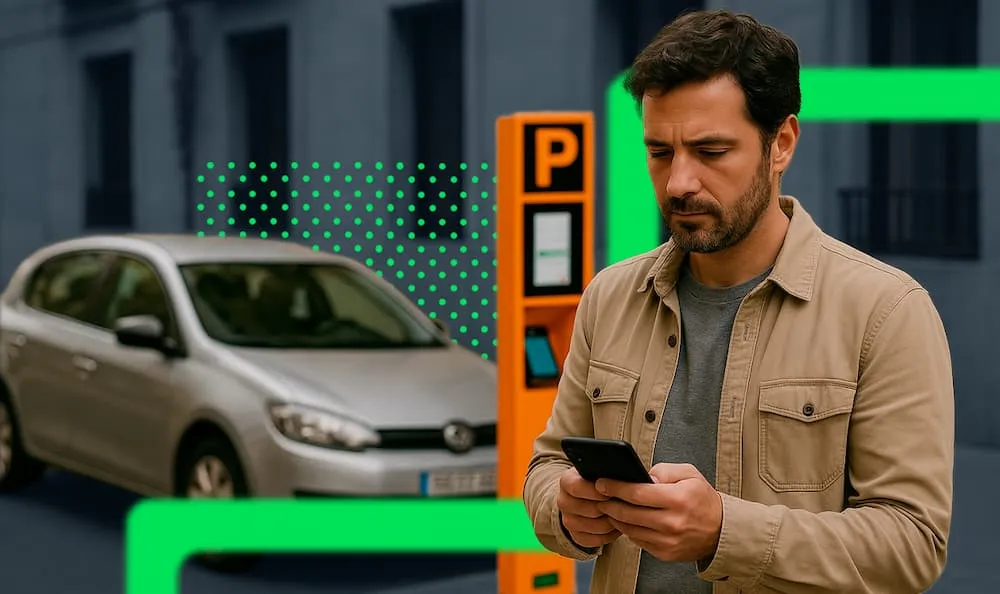
Drivers may use a compatible app to select the zone, enter their number plate and start a stay.
The app should explain the rules and authorised period.
No fee is collected for stays within the free allowance.
Registration through a website
A website may allow drivers to register without installing an app.
This can help users who prefer not to download another application.
Availability depends on the municipal system.
Registration at participating businesses
Authorised retailers may help drivers register their stays.
For example, a driver could visit a participating shop to register a number plate using an approved validation tool.
This approach may work well in shopping areas. However, shops need clear duties and procedures for fixing errors.
Are parking meters compulsory?
Not necessarily.
Digital systems can register stays through apps, websites or participating service points.
These can also coexist with existing parking meters.
The right channels depend on accessibility, local habits and municipal requirements.
A free digital parking zone should not assume every driver owns a smartphone or knows how to use an app.
How can time limits be enforced without payment?
Free parking does not mean unlimited parking.
To enforce limits, the system must know which vehicles have registered and when their authorisations expire.
Where number plates act as identifiers, enforcement staff can check a vehicle's permission status using connected tools.
They may verify whether an authorisation exists and whether the permitted period has elapsed.
Possible violations must be handled under the procedures established by the competent authority.
Technology cannot replace municipal legal authority or automatically turn every overstay into a valid fine.
Procedures are also needed for incorrect registrations, communications failures and discrepancies.
How to prevent repeated use of free parking periods
One question is whether drivers can start a new free session immediately after the previous one.
Without specific rules, users might register repeatedly to extend a stay beyond the intended limit.
The municipality must set conditions in advance.
These may include duration limits, registration frequency restrictions or rules preventing immediate renewals.
Controls must reflect local regulations and system capabilities.
Rules should be clear to drivers and verifiable by enforcement staff.
How can local businesses participate?
Free time-limited parking is often considered where access to shops is important.
Retailers may have two different roles.
They may act as authorised points for registering or validating stays.
They may also participate in parking-related initiatives included in the local scheme.
For example, systems can offer retailer-linked validation or benefits under agreed rules.
However, retailer participation should not be confused with unrestricted extensions of maximum parking time.
Any benefits or extensions must comply with the approved scheme.
Nor should increased shop sales be assumed without evidence.
How to tell whether free parking improves turnover
Success should not be measured solely by registered stays.
Authorities should assess space use and whether regulation meets its intended goals.
Useful indicators include:
- Registered stays: activity captured by the system.
- Stay duration: how long registered vehicles use the area.
- Hourly distribution: busiest periods.
- Registration incidents: difficulties using available channels.
- Potential violations: whether time limits are being respected.
- Observed turnover per space: how many different vehicles physically use a space where reliable information is available.
Digital registrations must be distinguished from actual physical occupancy.
If drivers must register voluntarily, the system may know which permissions were created but not detect every parked vehicle.
App data alone cannot prove how many spaces are physically empty.
Accurate occupancy estimates may require inspections, sensors or other data sources.
Practical example: a free parking zone in a shopping district
Imagine a town planning to regulate streets near a market and small shops.
Some vehicles currently remain parked most of the day, and the council wants to assess whether time limits would improve space sharing.
It considers a free scheme with a hypothetical 90-minute maximum during business hours.
Before implementation, it needs to define:
Usage rules. Streets, operating hours, maximum stay and any special permits.
Registration channels. App, website, validation points or alternatives.
Enforcement. How staff check authorisations and document potential violations.
Public information. Clear signs and understandable explanations.
Evaluation. Changes in space usage and possible effects on residents, visitors and retailers.
Technology supports operations, but the municipality establishes the rules.
Hypothetical example; it does not represent a real i+d3 deployment or measured results.
What to define before launching a free regulated zone
Municipalities should consider:
Policy objective. Identify whether long stays, retail access or another issue is the main concern.
Approved conditions. Establish hours, limits and groups eligible for special permits.
Accessibility. Provide alternatives for people who do not use mobile apps.
Enforcement. Define how stays and permissions are checked and incidents handled.
Data protection. Number plate systems must comply with relevant personal data requirements.
Performance measurement. Set indicators for reviewing the scheme after launch.
In Spain, the General Traffic Regulations recognise municipal parking regulation and time limits, with specific conditions established locally.
See the Spanish General Traffic Regulations.
How 3ParkOnStreet supports time-limited parking
At i+d3, we developed 3ParkOnStreet, a technology solution for regulated street parking.
It supports different channels for parking stays, alongside information and monitoring tools for authorities.
Depending on configuration, it can be used for paid or free time-limited models with apps, validation points and compatible components.
Deployment must match municipal regulations, enforcement procedures and contracted services.
Technology helps manage the rules; it does not define parking policy.
Frequently asked questions about free regulated parking
Can a regulated parking zone be free?
Yes. A municipality may establish time-limited parking with no fee, provided drivers respect the authorised hours and duration.
Must drivers register their number plates if parking is free?
That depends on local rules. Some schemes require drivers to register a stay; others use different methods to verify duration.
Can a free zone work without parking meters?
Yes. Apps, websites and validation points are alternatives. Choice should reflect municipal requirements and user needs.
What happens if drivers exceed the maximum time?
Local rules apply. Enforcement staff may record suspected violations and follow the established legal procedure.
Can an app show every available parking space?
Not necessarily. Registered permissions do not equal the physical presence of all vehicles. Reliable availability information needs occupancy data.
Regulating stay duration without charging for parking
Free time-limited parking can encourage turnover without imposing a parking fee.
To work effectively, schemes need clear rules, accessible registration methods and suitable enforcement procedures.
Technology can simplify these processes and provide information to evaluate performance.
At i+d3 we offer regulated parking systems for municipalities and operators.
Considering a free time-limited parking scheme? Contact our team to discuss management and enforcement options.