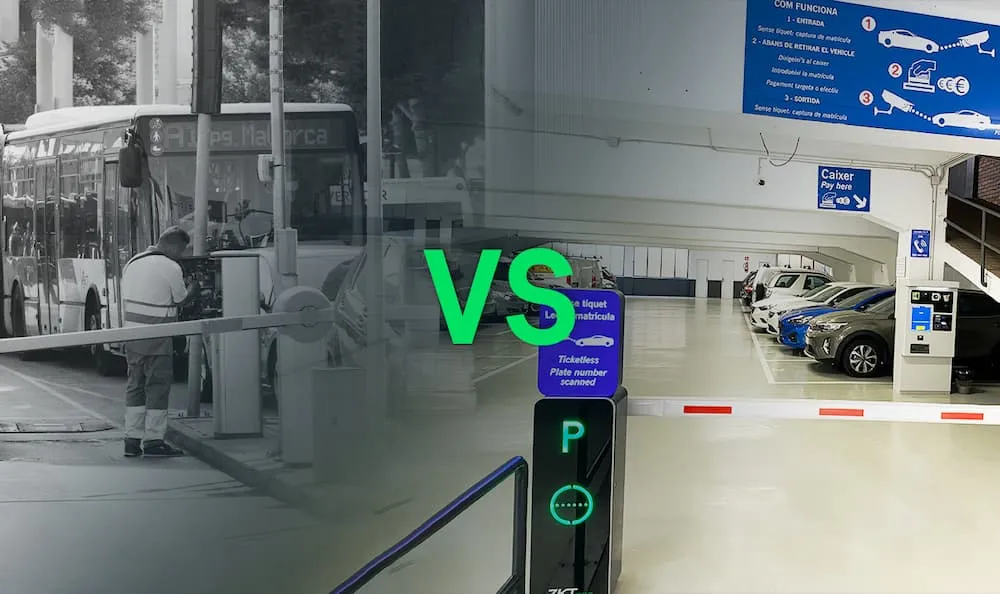
Traditional, ticketless or hybrid parking: which should you choose?
Is it better to keep a traditional ticket-based parking system or replace it with ticketless technology using number plates and digital credentials?
The best option depends on the car park. Traditional systems are familiar to drivers. Ticketless technology can reduce paper use and make access faster.
A third option is a hybrid system, combining tickets with number plate recognition, QR codes and other credentials.
This guide compares how they work, their benefits and what to consider before choosing.
What is the difference between traditional and ticketless parking?
The main distinction is how vehicles and parking stays are identified.
In traditional short-stay parking, customers receive a paper ticket on entry and use it to identify and pay for the stay before leaving.
Ticketless systems record entry without printing a ticket, using number plate recognition (LPR), digital QR codes or other credentials.
Both can manage entries, exits, tariffs and payments with suitable software.
The difference lies in how the stay is identified and checked. Both systems can use digital management.
Comparison: traditional vs ticketless vs hybrid parking
The following table summarises the main differences.
| Feature | Traditional | Ticketless | Hybrid |
|---|---|---|---|
| Typical identification | Paper ticket | Number plate or digital credential | Tickets and digital credentials |
| Paper at entry | Usually required | No entrance ticket needed | Depends on customer type |
| Access equipment | Ticket dispensers and readers | Cameras and/or digital readers | Combination of technologies |
| Payment | Machines, staffed tills or compatible channels | Machines, mobile or compatible channels | Several payment channels |
| Reliance on LPR | Not necessarily required | May be high when used as the main identifier | Lower where alternatives exist |
| Maintenance | Dispensers and readers | Cameras, communications and software | Depends on installed equipment |
| Reusing existing devices | Possible | Compatibility must be assessed | Supports gradual transition |
No system is universally best. Consider customers, traffic, infrastructure and business objectives.
Traditional systems: operation, advantages and limitations
Traditional systems usually identify stays with paper tickets containing barcodes or QR codes.
Drivers collect tickets on arrival, park, pay at a machine or staffed counter and present the validated ticket to exit.
This familiar model remains appropriate at many facilities.
When is keeping tickets sensible?
Traditional systems may suit a facility where:
- Existing equipment works well and has useful life remaining.
- Customers are familiar with the process.
- Removing consumables is not an urgent priority.
- Replacing infrastructure is not financially justified.
Tickets also do not prevent adding digital features.
For example, a car park can combine tickets for occasional customers with number plate recognition for subscribers, or add compatible payment channels.
What are the limitations?
Printing tickets uses paper and requires replenishment.
Printers, cutters and readers need maintenance and may fail.
Drivers must also collect and keep their tickets, adding an interaction to entry.
These factors do not make traditional systems unsuitable. But operators should include them when comparing running costs.
Ticketless systems: how parking without tickets works
Ticketless parking records stays without giving drivers paper tickets.
When using number plate recognition, an LPR camera identifies vehicles at entry and software creates the stay record.
Drivers can retrieve the stay using their number plate and pay through available channels.
At exit, the system identifies the vehicle again and checks whether departure conditions are met.
Depending on configuration, QR codes and other credentials can be used too.
Main advantages of ticketless parking
Fewer consumables. No entrance tickets means less paper and fewer refills.
Less reliance on printing mechanisms. Removing some mechanical parts may reduce certain maintenance tasks.
Convenient access. When a plate is recognised correctly, the driver need not collect or present a ticket.
Digital integration. Entry records can be linked to subscriptions, bookings, permissions and payments where systems support it.
What limitations should be considered?
Plate recognition depends on camera placement, lighting, weather and plate condition.
Dirty, damaged or obscured plates may be difficult to read.
Motorcycle plate position and direction of travel also matter.
Ticketless sites need procedures for entries that cannot be verified automatically.
Depending on the installation, options include QR readers, PINs, intercoms or remote assistance.
Electronics, communications and software still require maintenance.
Hybrid parking: combining tickets and digital access
Hybrid access control uses more than one identification technology at the same site.
For example, occasional customers can keep using tickets while subscribers enter using recognised number plates.
Online bookings can use QR codes while ticket readers remain available as an alternative.
This flexibility allows each customer group to use a suitable method.
When is a hybrid system useful?
It is particularly relevant when adding services without replacing all existing equipment.
It also suits facilities combining occasional customers, subscribers, reservations and different vehicle types.
For example:
- Short-stay customers: tickets or number plates, depending on configuration.
- Subscribers: plates or cards.
- Bookings: QR codes or plates.
- Incidents: alternative identification or assistance.
Hybrid systems enable gradual digital transition, although several technologies can add complexity.
Which system suits different car parks?
Choose based on operational requirements rather than novelty.
Busy public car parks
Ticketless access may reduce some interactions in high-turnover facilities.
Before adoption, assess traffic, reading reliability and incident response.
Hospitals and shopping centres
These facilities serve different customer groups.
Hybrid identification can accommodate occasional visitors, subscribers, employees and advance reservations.
Selection depends on access layout and services offered.
Hotels and company car parks
Number plate identification can make repeated access easier for registered users.
QR codes and temporary permissions may also serve guests, staff and visitors.
Assess connections to booking and user-management systems.
Residential garages and small car parks
Budget and user profiles are particularly important at smaller sites.
A functioning traditional system may be sufficient.
A simple ticketless configuration may also be viable for registered users or unattended operation.
Is ticketless parking cheaper than traditional parking?
Ticketless technology can reduce paper and certain printing-related costs.
But it is not always cheaper to install or maintain.
Compare total cost of ownership over a defined period.
Costs to analyse
Initial investment. Equipment, lane modifications, cabling and installation.
Maintenance. Inspections, repairs, replacement parts and technical support.
Consumables. Paper tickets and other materials.
Software and services. Licences, connectivity and digital features.
Operational incidents. Time spent resolving access, payment or identification problems.
A facility with compatible cameras and barriers may need fewer changes than one requiring new equipment across several lanes.
Financial comparisons should use specific proposals, not generic savings percentages.
What to review before switching to ticketless
1. Compatibility of existing equipment
Check which barriers, terminals, cameras and payment machines can remain.
Technical assessment is required because devices support different integrations.
2. Number plate recognition conditions
Review lane design, vehicle position, lighting and environmental conditions.
Additional cameras or alternative locations may be appropriate at some sites.
3. Alternative identification methods
Define what happens when vehicles cannot be recognised.
Clear procedures prevent a single error from blocking entry or exit unnecessarily.
4. Payment channels
Decide whether to retain physical machines, introduce mobile payments or offer both.
Access identification and payment methods are related but separate choices.
5. Data protection
Number plates can be personal data where they identify individuals.
Processing must therefore comply with applicable legislation, including user information, lawful basis, safeguards and retention.
The Spanish Data Protection Agency provides guidance.
6. Test before launch
Before activating ticketless parking, test real-world scenarios including different vehicle plates, subscribers, bookings, stays, payments and exit authorisation.
Also check how the system responds to unreadable plates and communications failures, adjusting settings and backup procedures before routine use.
7. Prepare the transition and customer support
When switching to parking without tickets, clearly explain entry, payment and exit procedures through signs and customer information.
Train staff and provide ways to request assistance.
Where traditional and ticketless access coexist, explain which method each user should follow.
A real-world example: ticketless parking at Baqueira Beret
Baqueira Beret illustrates ticketless operation under demanding environmental conditions.
i+d3's project uses number plate recognition for access and supports online reservations and payments.
Rear plate reading was added because snow can cover the front of vehicles at the ski resort.
The example shows that reliable ticketless operation depends on adapting technology to the site, not simply installing cameras.
Read the Baqueira Beret case study.
Find the right parking access control system
Choosing traditional, ticketless or hybrid access means determining what the car park actually needs.
At i+d3 we develop parking access control solutions combining tickets, number plates, QR codes and other identifiers, adapted to each facility.
Considering an access upgrade or transition to ticketless? Contact our team to discuss the most suitable approach.