


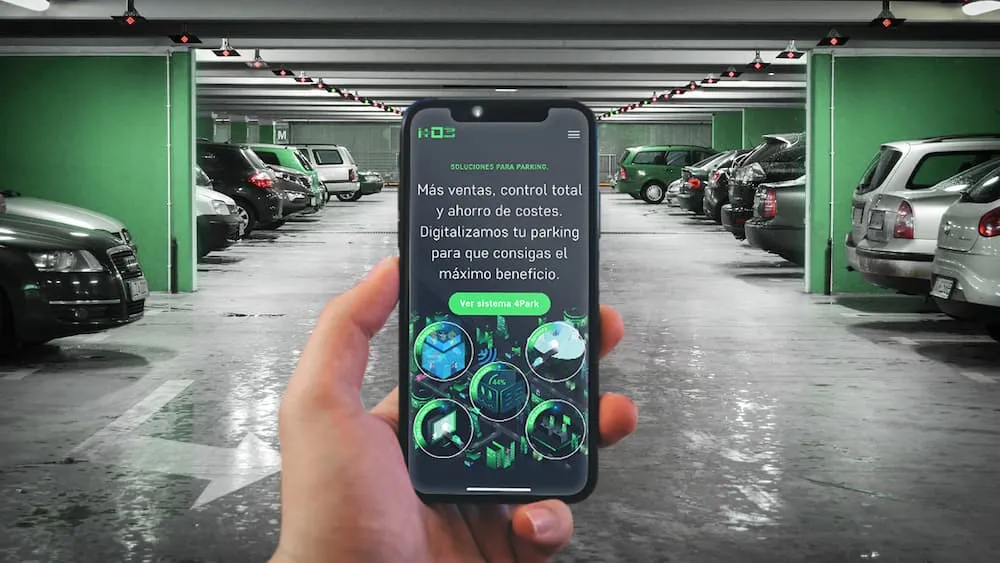
Why digitalise a car park? Benefits for management
Digitalising car parks changes how operators manage access, payments and customer services. The value comes from better information, not just new equipment.
Traditional equipment may work well. But as traffic and sales channels grow, manual work can become harder to manage.
Digitalising a car park means connecting operations and using data to improve control, efficiency and customer experience.
We explain the potential benefits, when to consider investing and how to evaluate the results.
What does digital parking management mean?
Parking digitalisation involves integrating technology and management tools to record, automate and monitor operations.
This may include vehicle entry and exit, payments, reservations, subscribers, occupancy and incident support.
Compared with standalone systems, the difference is a way to connect information. For instance, a vehicle entry can be linked to its stay, the associated payment and exit authorisation.
This gives operators a clearer view of daily activity without switching between separate tools.
Digitalisation does not necessarily require replacing all existing equipment. Reuse depends on its condition and compatibility.
What problems can arise in a car park with limited digitalisation?
Managing information manually or across disconnected systems can create operational difficulties.
Common examples include:
- Limited visibility: understanding occupancy, stays and revenue requires checking several systems.
- Repetitive administration: staff spend time reviewing operations, managing subscribers or checking payments.
- Difficulty investigating discrepancies: differences between access records, stays and payments may require manual checks.
- Reliance on on-site staff: some incidents and operations require physical intervention.
- Fewer sales opportunities: without digital channels, a facility may miss online bookings and customers.
Not every traditional car park experiences these problems. Their impact depends on facility size, activity and existing equipment.
Main benefits of digitalising a car park
Digital transformation can benefit owners, staff and drivers.
Greater control over operations and revenue
Connecting access, stays and payments makes everyday activity easier to track.
Managers can review recorded operations, identify incidents and check the relationship between vehicles and payments.
This traceability helps investigate discrepancies, although it does not eliminate errors or irregularities entirely.
Fewer manual tasks and more efficient management
Automation can simplify tariff calculation, access validation, stay records and subscriber permissions.
Staff can spend less time on repetitive tasks and use available resources more effectively.
Benefits will be greatest where processes currently require frequent manual intervention.
New sales and booking opportunities
Digitalisation can introduce commercial services that open up new sales channels.
For example, a car park may offer advance reservations, online subscriptions and different payment options.
Drivers can book before arriving or complete transactions on their phones.
These features do not guarantee higher revenue but provide additional ways to market parking spaces.
A more convenient driver experience
Customers can also benefit from digital management.
Depending on the technology, they may enter using number plates or digital credentials, book in advance or pay without visiting a payment machine.
Remote assistance can also help resolve certain incidents without relying solely on on-site personnel.
Decisions based on real information
One of the most valuable benefits is access to data that explains car park performance.
Peak hours, average stay duration and revenue trends can reveal opportunities for improvement.
A manager might find high weekday occupancy but low demand at weekends.
That information can guide commercial strategy, new products or resource allocation.
How can you tell whether digitalising a car park is worthwhile?
Before investing, identify the problems to solve and the improvements expected.
Potential signs that the operating model needs review include:
| Current situation | Improvement opportunity |
|---|---|
| Cash closing requires manual checks | Connect payments to parking stays |
| Occupancy is unknown at certain times | Record and review occupancy data |
| Subscriber administration is repetitive | Digitalise permissions and management |
| All reservations arrive by phone or email | Introduce online booking |
| Managers must visit the site to investigate incidents | Enable remote monitoring and assistance |
| Several car parks use separate tools | Centralise information |
Not every improvement needs to be implemented simultaneously.
For some car parks, payment management may be the priority; for others, online booking or supervising multiple facilities through one platform offers greater value.
How to measure the impact of parking digitalisation
To assess whether investment is delivering results, compare relevant metrics before and after improvements.
Operational and financial indicators
The most useful measures depend on each facility's objectives:
- Time spent on administration: shows whether manual workload has decreased.
- Access and payment incidents: helps assess operational stability.
- Occupancy rate: shows how available capacity is used.
- Revenue per available space: relates income to parking capacity.
- Digital channel sales: tracks bookings and other online services.
- Operating and maintenance costs: helps assess the efficiency of the new configuration.
For instance, introducing online booking should be evaluated both $1 and by additional revenue, associated costs and whether it increases occupancy or replaces sales from another channel.
Return on investment depends on the facility
Assessing profitability requires considering benefits alongside total project costs.
These include equipment, integration, licences or subscriptions, maintenance and staff training.
Compare these costs against savings, incremental revenue and measurable operational improvements.
Digitalisation does not automatically guarantee higher profitability. Value comes from choosing features that address real needs and measuring their results.
Must all equipment be replaced to digitalise a car park?
Not always.
A facility with barriers, payment machines, readers or other devices can evaluate compatibility with digital tools before replacing them.
Depending on the infrastructure, partial modernisation or gradual introduction of new features may be possible.
For example, operators may retain some equipment while adding an online management platform, payment channels or digital booking services.
The decision should follow a review of equipment, software, communications and integration requirements.
Frequently asked questions about parking digitalisation
Is it profitable to digitalise a small car park?
It can be, provided the features chosen meet the facility's needs. A small car park does not necessarily require the same equipment and services as a large one.
What are the benefits of digital versus manual management?
Primarily, greater operational traceability, easier access to information and opportunities to automate routine tasks. Actual benefits depend on previous processes and the solution introduced.
Does digitalising a car park mean eliminating tickets?
No. A digital car park can still use physical tickets. Ticketless systems and hybrid setups combining identification methods are also available.
How can you tell if the investment is working?
Set performance measures before implementation and compare them afterwards. Monitoring operational costs, revenue, occupancy, incidents and digital-channel performance is recommended.
Digitalisation as a tool for better management
The importance of digitalising a car park lies not just in upgrading equipment but in getting information and processes to work together.
When technology meets business needs, it can improve control, simplify operations and enable new customer services.
At i+d3, we develop parking hardware and software that connects access, payments, reservations and management tools, tailored to each facility.
Want to improve the management of your car park? Explore our parking digitalisation solutions to assess which features could add the most value to your business.


