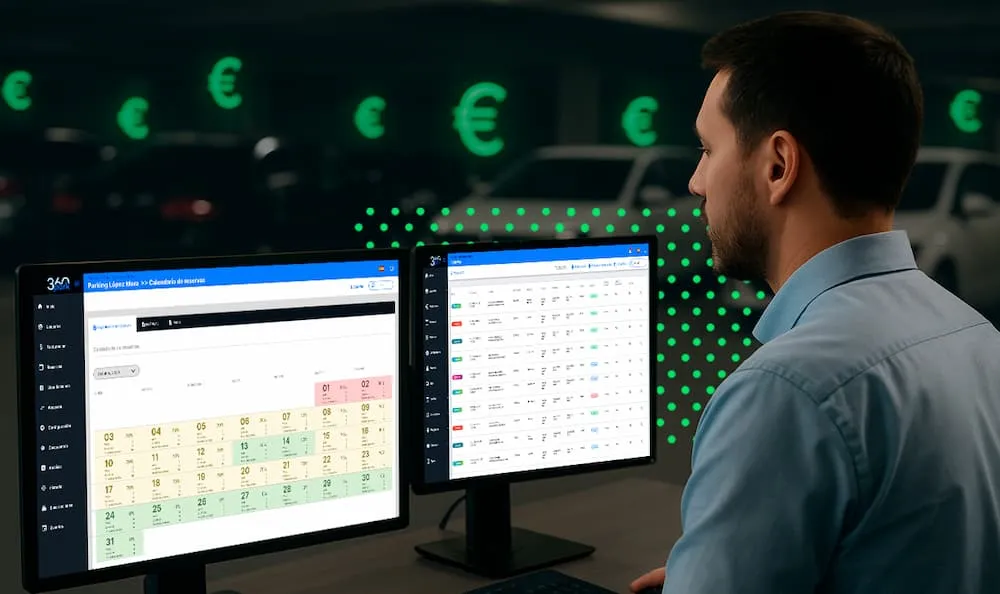
How to monetise parking data and create new revenue
Parking data can help increase revenue without adding spaces or selling personal information. Occupancy, bookings and sales records can reveal empty capacity and unmet demand.
Data alone will not increase revenue. Operators need to find opportunities, test ideas and measure results.
Here are four ways to create business opportunities using parking data.
What does monetising parking data mean?
Data monetisation means using information to create economic value.
Two approaches are possible:
Indirect monetisation: using operational information to develop products, attract new customers or improve space sales.
Direct monetisation: offering data services to other businesses, where there is demand and legal and contractual rules allow it.
For most car park operators, indirect monetisation is the more practical starting point.
For example, observing low occupancy at certain times could motivate a new parking product for those hours.
The extra revenue comes from spotting opportunities in the data, not selling the records.
What data can reveal commercial opportunities?
Parking systems can provide information about facility use, depending on their features.
| Available information | What it reveals | Potential decision |
|---|---|---|
| Occupancy by time | Periods with spare capacity | Products for particular hours |
| Stay durations | Short and long-stay patterns | Passes and duration-based products |
| Reservations and channels | Sources and changes in sales | Review distribution strategy |
| Subscriptions and customer types | Relative weight of booking models | Recurring parking products |
| Promotion usage | Response to offers | Evaluate campaigns and partnerships |
Use comparable periods and verify records are accurate.
A booking does not always mean a vehicle is parked. Sales from external platforms may also appear in the system.
Keep booking, payment and occupancy records separate to avoid counting activity twice.
1. Create products for low-demand periods
One opportunity arises when occupancy varies significantly by hour.
A car park may be busy in the morning but relatively quiet in the afternoon.
This could support offers for shift workers, afternoon passes or nearby activities.
Products must match actual local demand and capacity available for sale.
The goal is not filling every empty space at any price, but finding revenue that would not otherwise exist.
Check whether the offer attracts new customers or merely discounts stays that would have sold anyway.
More reservations do not automatically mean incremental revenue.
2. Identify which sales channels contribute most
Car parks can sell through their own websites, apps, business agreements and external booking platforms.
Channels differ in booking volumes and commercial terms.
Sales data helps show their relative contribution over time.
Compare more than gross revenue: commissions, discounts, cancellations and other expenses matter.
An aggregator might deliver many bookings while direct sales have a different cost structure.
The aim is not necessarily eliminating intermediaries but understanding each channel's contribution to focus commercial efforts.
Account for the users and demand periods each channel serves.
3. Design products for companies and recurring users
Data can also reveal the need for different parking products.
An office-area facility may serve different customers from one near a hospital, station or event venue.
Usage hours, stay lengths and booking patterns help identify these distinctions.
Potential products include:
- Passes valid during particular hours.
- Subscriptions for recurring needs.
- Parking reservations for businesses or groups.
- Event-linked parking packages.
Individual personal records are not necessarily needed.
Aggregated patterns can often support an initial commercial hypothesis.
Feasibility depends on capacity, operating conditions and available tools.
4. Build commercial partnerships with nearby businesses
Location can create opportunities with hotels, retailers, restaurants, gyms and other local organisations.
Usage data shows when spare capacity overlaps with potential partners' operating hours.
A restaurant may want to provide parking benefits during meals, or a shop may offer discounts with qualifying purchases.
Commercial agreements can fund or validate certain stays under agreed rules.
The value lies in using activity patterns to design partnerships, not selling driver information.
Measure stays associated with the agreement, revenue and discount costs.
i+d3 offers retail validation and discount voucher management, configured to suit each project.
How can an occupancy map reveal opportunities?
An occupancy map shows how spaces or zones are used.
Detail depends on available data.
Entry and exit logs can support overall occupancy estimates, while identifying individual space status requires suitable detection.
For commercial planning, trends across hours, weekdays and seasons can be more valuable than a map of currently empty spaces.
Useful questions include:
- Are there recurring periods of spare capacity?
- How do weekdays differ from weekends?
- When is demand too high to accept more bookings?
- How much capacity must remain available for subscribers?
Study capacity that can support new offers without affecting existing commitments.
Read our guide to parking data, sensors and platforms.
Practical example: finding a sales opportunity
Imagine a 60-space urban car park.
Over several weeks, its average afternoon occupancy is 24 spaces, or 40%.
Before selling more spaces, the operator must account for reserved subscriber and booking capacity and day-to-day variation.
It may then test a limited afternoon offer.
During the trial, measure:
New sales. Stays sold using the offer.
Additional revenue. Sales from users who did not previously park there.
Operational impact. Conflicts with other parking products.
Associated costs. Commissions, discounts and marketing expenses.
Continue only if the trial generates positive incremental contribution without harming operations.
If most buyers would have paid a higher price anyway, the offer may not be worthwhile.
Hypothetical example, not actual results from an i+d3 project.
How to test a data-based commercial opportunity
Define a commercial hypothesis
For example: “There may be demand for an afternoon pass because spare capacity is regularly available.”
Set trial conditions
Define dates, products, spaces, intended customers and purchase conditions.
Measure results
Compare sales and use with equivalent periods, accounting for events and demand changes.
Evaluate economic contribution
Deduct the initiative's costs from additional revenue and check whether it displaced existing sales.
That distinguishes business growth from simply increasing transaction counts.
Can occupancy data be sold to third parties?
Occupancy information may interest mobility platforms, authorities and other services.
But usefulness does not prove that someone is willing to pay for it.
Before considering sales, examine demand, data rights, collection methods and sharing safeguards.
Aggregated and anonymous data are not synonymous.
The Spanish Data Protection Agency explains that plates may be personal data and anonymisation must reasonably prevent identification.
Removing names or plates does not necessarily prevent re-identification.
Pseudonymised data can remain subject to privacy law.
Any external data arrangement needs review of purpose, lawful basis, contractual permission and re-identification risk.
Read the AEPD guidance on anonymised data.
For most operators, internal commercial uses are a more practical first step than selling databases.
How i+d3 supports commercial use of parking information
i+d3 develops parking access and management systems that work with stays, bookings, occupancy and payments, depending on installed features.
This information can support operational insight and commercial decisions.
Our online sales solutions offer reservations, passes, subscriptions and business or event products through compatible channels.
Analytical and sales capabilities must suit available data, systems and each project's requirements.
Not every facility needs identical tools.
Frequently asked questions about parking data monetisation
What does monetising parking data mean?
Using business information to create economic value, such as finding new products, improving sales or exploring data-based services.
Must personal data be sold to generate revenue?
No. Aggregated occupancy, time and product patterns can guide commercial decisions without selling drivers' personal information.
Which data is most useful?
Usually occupancy by time, stay duration, reservations and sales-channel performance, depending on the business.
Do occupancy maps automatically increase revenue?
No. They reveal patterns; creating revenue requires useful products and real customer demand.
How do you evaluate an initiative?
Compare incremental income with costs and consider whether it attracted new demand or replaced existing sales.
Data creates value when it supports commercial decisions
Parking records can reveal opportunities hidden in daily operations.
Occupancy, reservations and channel performance can help design offers and partnerships.
The goal is not accumulating data or selling personal records, but identifying opportunities and testing their real financial contribution.
At i+d3, we connect parking management with commercial services.
Discover our online parking sales solutions to tailor products and channels to your needs.
Want to find additional revenue opportunities using parking information? Contact our team to review your operations.