How parking systems have evolved over the past 20 years
Parking technology has changed greatly over the last 20 years. Local access and payment equipment now connects with bookings, payments and management platforms. Between 2006 and 2026, number plate recognition, mobile payments and online tools created new options for car parks.
However, traditional systems have not disappeared. Technology has enabled new features, different access methods and solutions tailored to each facility.
Here are the developments that have transformed the parking experience.
How did car parks work 20 years ago?
In 2006, many car parks already had automatic barriers, ticket dispensers, pay stations and software for managing tariffs and subscribers.
Automation is therefore not new. The key difference was the level of connectivity and a way to integrate separate processes.
Operations mainly relied on equipment installed at each facility. Drivers collected a ticket, paid at a machine or staffed counter and presented their ticket on exit.
Many tasks were already automated. However, online bookings, remote access to data and system integrations were less common.
The biggest change over two decades has been not just automating parking, but connecting its processes.
Four stages in parking technology evolution
Parking has changed gradually. These periods show general trends, not exact launch dates. Adoption varies by country and facility.
2006–2010: established automated systems
Access and payment equipment already formed the technological foundation of many car parks.
Barriers, physical tickets and payment machines managed entries, exits and payments with limited staff intervention.
Management programs handled tariffs, users and transactions, although many facilities relied primarily on local systems.
Technology focused on essential tasks: identifying a parking stay, calculating the charge and controlling vehicle movements.
2011–2015: better identification and occupancy monitoring
Developments in cameras, sensors and information systems expanded monitoring capabilities.
Automatic number plate recognition (LPR/ANPR), already in existence, gained new applications in vehicle identification and access management.
Space detection and guidance systems also provided more detailed information about available parking spaces.
Technology began providing more than automation: useful data about facility utilisation and information to help drivers find spaces.
2016–2020: growth of digital services
Mobile applications, booking platforms and new payment methods changed how drivers interacted with car parks.
Purchasing parking no longer depended entirely on arriving at the facility.
Drivers gained more ways to book in advance, manage stays and pay digitally.
Operators could reach customers through additional commercial channels.
Connecting these services with existing equipment became important to avoid managing bookings, access and payments separately.
2021–2026: from individual devices to connected systems
One of the most significant recent developments is the integration of multiple functions within management platforms.
Access, payments, bookings, subscribers and occupancy information can be coordinated through connected local, online or hybrid systems.
For example, an online reservation can be linked to a vehicle's registration number, used to authorise entry and connected to the parking stay and its payment.
Remote management also enables operators to supervise multiple sites and review operational information without visiting each facility.
The goal is not simply more advanced equipment but systems that exchange information and work together.
From traditional to connected parking: what has changed?
The transformation is particularly clear when comparing everyday processes.
| Process | Traditional model | Modern connected systems |
|---|---|---|
| Access | Physical ticket, card or credential | Ticket, number plate, QR or other digital credentials |
| Payment | Automatic machine or staffed counter | On-site, self-service and mobile payment options |
| Bookings | On-site sales or separately managed reservations | Online bookings linked to access and parking stays |
| Occupancy | Counts and reports from local systems | Zone information and connected monitoring tools |
| Management | Mainly local software and equipment | Local, online or hybrid management with centralisation options |
These options are not mutually exclusive. A modern car park can still use physical tickets while offering online bookings, number plate recognition and remote supervision.
The major shift: connecting the whole car park
One of the most important advances is coordinating activities that were previously managed independently.
Consider one parking stay.
In a traditional model, a driver arrives, collects a ticket, parks, pays and presents proof of payment when leaving.
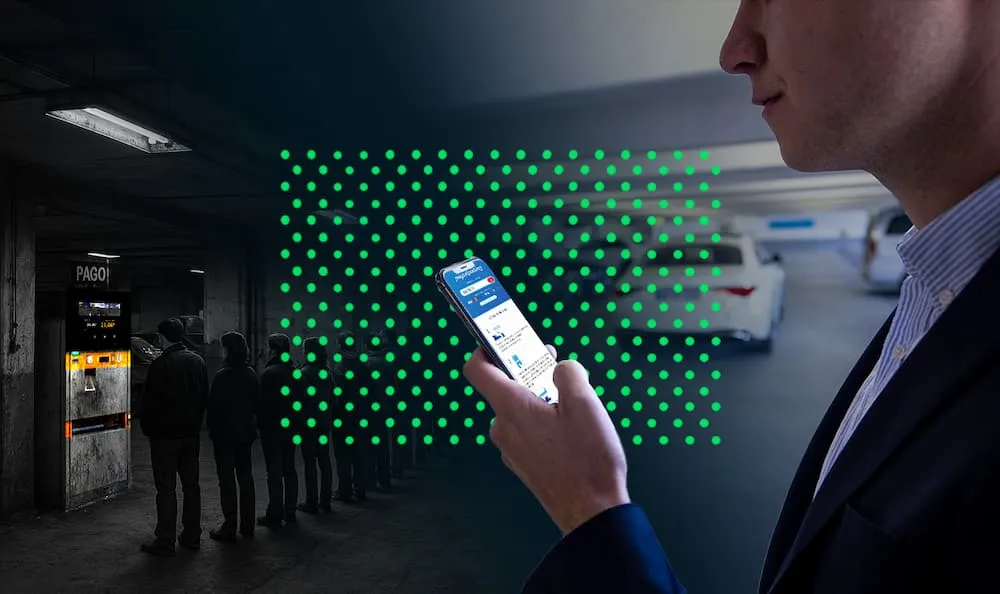
In a connected system, that driver can book in advance, enter using number plate recognition, pay by phone and exit without a paper ticket.
Both models manage parking. The difference lies in the choices available and how operations are connected.
For operators, integration can bring bookings, access and payments into one management platform and reduce some manual checks.
Have new systems replaced traditional ones?
Not necessarily. There is no single model for parking technology evolution.
Ticket-based systems remain suitable for some sites, while others use number plate access or hybrid configurations.
Choice depends on traffic volumes, user profiles, existing infrastructure and operational requirements.
Modernisation does not always mean replacing every machine. Some facilities can retain equipment and add compatible features.
Technology has expanded the available options so systems can be adapted to each car park.
What can we learn from parking technology evolution?
Three developments stand out.
Technology now goes beyond access and payment. Systems can link stays to reservations, customers, occupancy and additional services.
Information has become more important. Operational data helps operators understand activity and make better management decisions.
Integration matters increasingly. Facilities may need additional services without repeatedly replacing reliable equipment.
Technology should respond to actual needs rather than be adopted simply because it exists.
Where is parking technology heading?
The last two decades point towards greater connectivity between equipment, software, sales channels and mobility services.
Data analytics, platform integrations and automation will continue offering opportunities, although adoption depends on each operator's resources and needs.
For current developments, read our article on parking industry trends and challenges in 2026.
Frequently asked questions about parking evolution
When did car parks begin using automation?
Parking automation began before 2006. Barriers, tickets and pay stations were already installed in many facilities. Recent decades have focused on digital identification, connectivity and service integration.
What has been the biggest technological change over 20 years?
One major shift has been from locally managed devices and software to integrated platforms connecting access, bookings, payments and information.
Have physical parking tickets disappeared?
No. Tickets remain in use at many sites alongside ticketless and hybrid systems offering different identification methods.
What is the difference between automated and connected parking?
Automated parking uses equipment to carry out tasks without constant manual intervention. Connected parking also enables systems to share data and coordinate access, payments, reservations and monitoring.
Twenty years towards more connected parking management
Parking technology has evolved not simply by replacing old equipment, but by improving how processes work and interact.
At i+d3, we have over 20 years of experience developing parking technology, supporting the industry's transformation through access control, payment and management solutions suited to different facilities.
Explore our parking management solutions and how they can meet your car park's needs today.